


10 Jul Self-Compassion: How to Stop “Sucking It Up” and Start Supporting Yourself
 “Just get over it.”
“Suck it up.”
“Stop being so sensitive.”
Many of us have heard phrases like these throughout our lives. Some of us may have even learned to say them quietly to ourselves whenever we feel overwhelmed, hurt, anxious, tired, or unsure.
We live in a culture that often praises toughness, productivity, and resilience. There is nothing wrong with wanting to persevere through difficult moments. The problem is that perseverance is often confused with emotional suppression.
We are taught to push through discomfort, ignore the signals from our bodies, minimize our needs, and keep going no matter what. Over time, this “suck it up” mindset can leave people feeling isolated, exhausted, disconnected from themselves, and ashamed of having normal human emotions.
But there is another way.
Self-compassion offers a gentler and often more sustainable approach to navigating stress, mistakes, grief, anxiety, and the many challenges life can bring. It does not mean avoiding accountability, giving up on goals, or pretending everything is okay. It means learning how to meet yourself with support instead of punishment.
As a therapist, I often see people who have spent years trying to power through. They may arrive feeling burned out, anxious, numb, or deeply frustrated with themselves. Many believe they are somehow failing because they cannot simply “get over” what they are feeling.
But your mind and body are not designed to endlessly absorb stress without support. They are designed to notice, respond, process, recover, and seek safety. Self-compassion can be one meaningful way to begin reconnecting with that natural capacity.
What Is Self-Compassion?
Self-compassion means responding to yourself with the same care, patience, and understanding you might offer someone you love.
Researcher Dr. Kristin Neff describes self-compassion as involving three core elements: mindfulness, common humanity, and self-kindness.
In everyday life, self-compassion can sound like:
- “This is hard right now.”
- “It makes sense that I am struggling.”
- “I am not the only person who has felt this way.”
- “What would support me in this moment?”
- “I can hold myself accountable without attacking myself.”
Self-compassion is not self-pity. It is not an excuse to avoid responsibility. It is not a way of saying that pain does not matter.
Instead, it is a practice of acknowledging pain honestly while choosing to respond with warmth rather than shame.
Why Is It So Hard to Be Kind to Yourself?
For many people, self-criticism can feel familiar, automatic, and even productive.
You may have learned that being hard on yourself is what keeps you motivated. You may worry that kindness will make you lazy, selfish, weak, or less successful. You may have grown up in an environment where emotions were dismissed, minimized, or treated as inconvenient.
Common fears include:
- “If I stop criticizing myself, I will lose my drive.”
- “Being kind to myself feels selfish.”
- “I should be able to handle this on my own.”
- “Other people have it worse, so I should not complain.”
- “If I let myself feel this, I will fall apart.”
These fears are understandable. For some people, self-criticism began as a protective strategy. It may have been a way to avoid mistakes, gain approval, stay alert, or try to prevent rejection.
But a harsh inner critic rarely creates lasting safety.
One client once described her inner voice as “a drill sergeant who never takes a day off.” If she made a small mistake at work, she would replay it for hours, call herself names, and question whether she was competent enough for her career.
She believed that this criticism kept her sharp.
Instead, it kept her anxious, exhausted, and afraid to take creative risks. Her inner critic was not motivating her. It was draining her nervous system.
The Connection Between Self-Criticism, Stress, and the Nervous System
When we are under stress, our bodies often respond before we have fully named what is happening. You may notice a racing heart, shallow breathing, tight shoulders, a clenched jaw, digestive discomfort, restlessness, numbness, or the urge to shut down.
Some therapeutic frameworks, including polyvagal-informed approaches, help people understand how the nervous system responds to perceived safety and threat. When we repeatedly ignore our needs or push ourselves beyond our limits, the body often continues to signal that something needs attention.
Telling yourself to “get over it” may not make anxiety disappear. It may simply add shame to an already difficult moment.
Self-compassion can create a pause.
That pause might sound like:
“I am really overwhelmed right now. I do not need to solve everything this second. I can take one breath, one step, and offer myself some support.”
Mindfulness and relaxation practices may help some people manage stress and anxiety symptoms, especially when used alongside appropriate professional care.
Self-compassion is not a substitute for therapy, medical care, medication, or trauma treatment when those supports are needed. It can, however, be a meaningful part of building a more supportive relationship with yourself.
Can Self-Compassion Help With Anxiety and Emotional Resilience?
Self-compassion does not erase difficult feelings. It does not guarantee that anxiety, grief, trauma responses, or stress will disappear.
What it can do is change the way you relate to those experiences.
Instead of adding another layer of judgment:
“Why am I like this?”
“I should be over this by now”
Self-compassion invites curiosity and care.
Research suggests that self-compassion interventions may support lower levels of stress, anxiety, and depressive symptoms for some people, while also strengthening emotional regulation and resilience.
This matters because healing is often not about forcing yourself to feel differently. It is about creating enough internal safety to stay present with what you are feeling.
Four Ways to Practice Self-Compassion in Daily Life
1. Notice the Voice of Your Inner Critic
The first step is not getting rid of your inner critic. It is noticing it.
Pay attention to the words you use when you make a mistake, feel emotional, or fall behind on something. Would you speak to someone you care about in the same way?
You may begin to notice phrases such as:
- “I am so stupid.”
- “I always mess everything up.”
- “I should be stronger than this.”
- “I have no right to feel this way.”
Rather than fighting these thoughts, gently name what is happening:
“My inner critic is here.”
That small shift can help create distance between you and the thought.
You are not your inner critic.
You are the person noticing it.
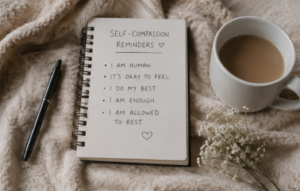 2. Name What You Are Feeling Without Judging It
When emotions feel intense, it can help to put simple language around them.
Try saying:
- “This is anxiety.”
- “This is disappointment.”
- “This is grief.”
- “This is a moment of overwhelm.”
You might place a hand on your heart, chest, arm, or stomach while you do this. Gentle self-touch can be grounding for some people, especially when paired with slow breathing and a supportive phrase.
The goal is not to force yourself to calm down. The goal is to acknowledge what is here without abandoning yourself in the process.
3. Remember That You Are Not Alone
Pain can be isolating. When we are struggling, it is easy to believe that everyone else is handling life better than we are.
Self-compassion includes the reminder that struggle is part of being human.
You might say:
“Other people have felt this way, too.”
“I am not alone in having a hard moment.”
“It is okay to be human.”
This does not minimize your experience. It simply reminds you that imperfection, uncertainty, and emotional pain are not personal failures.
4. Offer Yourself One Small Act of Care
Self-compassion becomes more meaningful when it is practiced in tangible ways.
Ask yourself:
“What would feel supportive right now?”
The answer may be simple:
- Drink a glass of water.
- Step outside for five minutes.
- Take a break from your screen.
- Text someone safe.
- Let yourself cry.
- Eat something nourishing.
- Sit quietly with a cup of tea.
- Go for a gentle walk.
- Reschedule something that can wait.
For those building a more supportive daily nervous system routine, my ebook, 33 Nervous System Supports, offers practical, therapist-informed ideas you can use at home, at work, or during stressful moments.
A weighted blanket, such as a Bearaby Weighted Blanket, may also feel comforting for some people who enjoy deep pressure and are creating a calmer evening routine. It is important to choose what feels safe and comfortable for your body, rather than forcing any tool or practice that does not feel right.
Journal Prompts for Building Self-Compassion
Take a few quiet minutes with one of these questions:
- Think of a recent moment when you were hard on yourself. What did your inner critic say?
- What might a compassionate friend say to you in that same situation?
- What emotions were you taught were unacceptable or inconvenient?
- What is one small act of kindness you can offer yourself today?
- When do you feel most disconnected from your body or your needs?
When Therapy Can Help
Self-compassion can be challenging, especially if you have a history of trauma, chronic stress, emotional invalidation, or relationships where your needs were not consistently met.
For some people, being kind to themselves can initially feel uncomfortable, unsafe, or unfamiliar. That does not mean you are doing it wrong. It may simply mean that your nervous system has learned to associate self-protection with criticism, self-reliance, or emotional shutdown.
Therapy can offer a supportive space to explore these patterns with care.
Approaches such as trauma-informed therapy, EMDR trauma therapy, Somatic Experiencing and mindfulness-based practices may be worth exploring with a qualified professional, depending on your needs and goals.
You do not have to earn rest, care, or compassion by reaching a breaking point.
A Gentle Reminder
Learning self-compassion is not about becoming perfect at being kind to yourself. It is about practicing a different response, one small moment at a time.
Some days, self-compassion may mean offering yourself a kind phrase. Other days, it may mean setting a boundary, asking for help, taking a break, or allowing yourself to feel what you feel.
You do not have to “suck it up” to be strong.
Sometimes strength looks like staying connected to yourself when life feels difficult.
If you are looking for in person appointments in Brooklyn, New York, or virtual sessions in Connecticut, Rhode Island or Michigan and would like support in building a more compassionate relationship with yourself, reach out to set up your a free 15 minutes consultation.
No Comments